
The study of Plutarch’s lives is a distinctive part of a Charlotte Mason curriculum. But why did she insist on reading these verbose biographies of ancient Greek and Roman leaders? In today’s podcast we’ll discuss the principles of the subject of Citizenship and learn why Plutarch is relevant for today’s students.
Listen Now:

Charlotte Mason, Volume 6 (Amazon) (Living Book Press – use code DELECTABLE for 10% off!)
ADE Vol 6, Chapt 10 Reading List
Episode 29: Citizenship – Everyday Morals & Economics
Emily
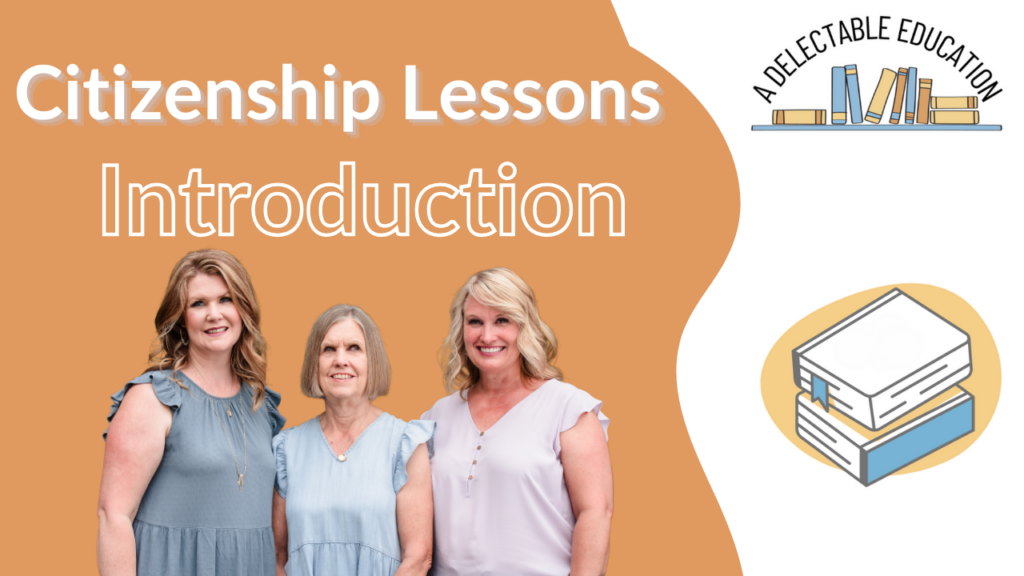
Welcome to A Delectable Education, the podcast that spreads the feast of the Charlotte Mason Method. I’m Emily Kiser and I’m here with…
Liz
…Liz Cottrill…
Nicole
…and Nicole Williams.
Emily
We hope you’ve had a wonderful holiday break and enjoyed the conference talks from Morgan and Cathy that we’ve shared over our break. As we continue our series through a Charlotte Mason curriculum, we hope you’re reading along with us and deepening your understanding of the Charlotte Mason method. And you can find our reading schedule to keep up with us in our show notes.
This month we’re turning our attention to Citizenship, a subject that Charlotte Mason believed was crucial to developing our children’s moral imagination. So we thought we would take some time at the beginning of our series to talk about why Citizenship is so important in its place in the whole curriculum as a whole.
Charlotte Mason believed that Citizenship as a subject was crucial to developing a child’s moral compass. In fact, her ultimate goal for education was for a child to grow up to be a magnanimous or generous-hearted citizen of his own country and beyond, to see his purpose not to live for himself but to serve God and his neighbor. Essentially that’s what it means to be a good citizen in her definition.
So students begin to get their ideas of Citizenship from many of their lessons in Form 1. Charlotte Mason tells us that these ideas come most notably from their Tales and Fables, which is their Form 1 Literature, and also History, especially biography. And of course, their Bible lessons.
And then as they move into formal Citizenship lessons, which begin in upper elementary or we would say Form 2, grades four through six, their ideas become more definite. She said, “What to avoid and how to avoid it is knowledge as important to the citizen, whether of the city of God or of his own immediate city, as to know what is good and how to perform the same.” And that is what she thinks they get out of Citizenship lessons.
So they explore these ideas. They weigh actions and consequences of other men through the literary form of their school books, which are a far better teacher than our exhortations, our lectures, because they’re inspiring them to live up to the highest ideal and they see that objectively or through another person’s life without that immediate push on them from us.
Liz
And you’re saying we’re not super inspiring as parents.
Emily
Or maybe they just tune out our things. Because, what do you know mom? But here we have – this is written in a book.
Liz
Yeah, more authority.
Emily
Yeah, Charlotte Mason says children familiar with the great idea of a state…in the sense not of a government, but of a people. So when you hear that word “state”, think she means the people of a nation. Children learn readily enough about the laws, customs, government of their country. They learn too, with great interest, something about themselves, mind and body, heart and soul, because they feel it as well, to know what they have it in them to give to their country.
So Nicole, would you now tell us a little bit about the practical details of what this looks like across their whole education, like 1st through 12th grade?
Nicole
Yeah, for sure.
In Form 1, there is not a separate Citizenship lesson on the timetable, but as you said, the work is already beginning through their History readings, tales, fables, stories of great men and women, and the children are first drawing conclusions about what makes a good leader at this age, a good neighbor, a good citizen, and they’re beginning to see the relationships between their personal character and the good of the community, or at least somebody’s personal character and the good of the community.
And then when they reach Form 2B, so that’s fourth grade, Citizenship is given its own time slot on the timetable. The lessons are still rooted in story, though at this point they’re learning historical accounts of Rome. And now we’re intentionally asking them to notice why certain choices matter. Maybe we’re having conversations at the end of the lessons. And they begin to connect dots between leadership and decision making and the flourishing of a community. They’re also introduced to the structure of local government because a worthy citizen not only understands their nation’s history but how their community is organized.
Now as they move into Form 2A in fifth grade their ideas grow deeper and this is where we get Plutarch, he finally takes center stage, and the moral and political challenges of statesmanship become more complex. The students at that point are learning to discern motives and way actions and see that decisions are rarely simple, and they learn to value proportion, seeing the needs of the whole before the desires of the individual.
Then in Form 3 and 4, so that’s grades 7 through 9, we expand this vision. And alongside Plutarch, students began reading the first book of Ourselves, where they’re introduced to kind of a map of human nature, its noble possibilities, and its vulnerabilities, where things can go awry. And this self-knowledge is essential to true Citizenship because it teaches our personal character and that that is part of our public contribution.
Emily
Yes, what we do and think and act as individuals has a bearing on society as a whole.
Nicole
Absolutely, for good or bad.
Emily
Exactly.
Nicole
So Charlotte Mason also assigned books that introduced them to social and industrial life and economics and responsibilities. We’re going to talk more about that in our episodes on the individual forms.
So then in 5 and 6, the subject name changed to Everyday Morals and Economics and the work becomes both philosophical and practical. And just as a side note, Plutarch is left off at this point. We’re going on to new things.
Emily
Remind us what grades Forms 5 and 6 are.
Nicole
Oh, yes. Grade 10 through 12. The last three years, they continue reading Ourselves. But now they’re reading book two of Ourselves, which is a little more in depth.
Emily
And direct.
Nicole
Yes. And they’re also looking at works that teach them about political thought and ethics and economics. The aim here really is to equip them to enter adult life and to think clearly and act justly and to contribute wisely and not just in the voting booth but in all ways that Citizenship shapes their community. So yeah, I mean just a big span.
Emily
Yeah and really we start with the ideal, they’re getting these ideas very generally, they become more definite, then they become applied to themselves, and then they can become practical to their place in what country they live in, the laws that prepare them to move out and to live.
Nicole
And even the city, I mean the local government, things like that. What does this look like in your church and your home?
Emily
Yes, exactly. So, mom, you speak with hundreds of Charlotte Mason parents and I’m sure you have some challenges, people pushing back like, but really is this important? or whatever. Would you share with us some of their common questions, or hesitations maybe even?
Liz
Yeah and I think part of why this feels like an unnecessary or unfamiliar subject is sort of what you were saying Nicole about learning to think beyond “me”, which is a challenge in our particular culture at this time because we’re very individualistic in our thinking. And I think we forget that children are learning a lot of these things incidentally, what did she say, “by the way”, because from birth children are learning about the people around them and what it’s like to live in a family group and then they meet outsiders and that extends their ideas, whether it’s the store clerk or neighbors, friends, families, coaches, sports teams, what it’s like to operate together and how order is maintained and how to cooperate and respect others to value and to live under an authority, actually.
And as they grow up, they become interested in who rules and how, and their concern starts to, you know, I think we see this in even older elementary children. They become concerned about character and morals of people around them in society. They hear about things that are going on and how…there are arguments about how to preserve liberty and justice for others and those kinds of things. They observe problems and they pick up on our inconsistencies. They have, especially I think by the time they’re approaching adulthood as teenagers, they’re interested in government. Children have seen mailmen and garbage collectors and all kinds of different institutions that we have and take for granted, but as they get older they start to wonder how does all this work and where did this come from?
But they have been internalizing all these standards from their history and literature like you said from day one of school, or should I say day one of reading in general, and all along they’ve been forming opinions and they’re being challenged about right actions and choices of people and that all goes into their learning about how to be a responsible citizen I think.
Emily
You know, one objection, maybe I hear a lot about how Charlotte Mason thinks about this subject or some of the ideas is her whole idea about the the state. You know, it’s right in the early parts of Home Education. So if people start at volume one, they start reading it. Especially, I think this is probably a pretty niche idea for American conservative homeschooling families. We see State capitalized and we think, but I’m not raising my child for the State.
So I would just push back or challenge you to think about what is she exactly meaning? She tells us, I’m not talking about the government, I’m talking about the people. And for better or worse, we live in a society. And I do think this is rooted in the two great commandments, right? We serve God by loving our neighbor, right? We love God by loving our neighbor.
Liz
And we were created as social beings and we live in community and we’re not going to be able to avoid that.
Emily
Yeah, and I think as homeschoolers, we have a extra hurdle that we have to help our children overcome in that their whole education is tailored to them, what time they wake up, often is maybe even if we enforce it as a family, it’s not just them, but it’s a very small group of people. And really, I think these ideas are helping them to think bigger and that they are not just living for themselves, but living. They have to die to themselves, as we’re called to do, but to consider the needs and wishes of others around us.
Nicole
And I think that Mason isn’t just putting it in like, let’s not, let’s be humble. It’s more like, let’s look at how this really plays out. When somebody makes this decision, here’s what happens.
Liz
How does it affect all those people?
Nicole
Inspiring tales of like, ooh, I don’t want to be like that one. I want to be like this.
Liz
Yep.
Emily
And then I think the key about Ourselves, which I know we’ll talk about in subsequent episodes, but to really see your potential and not just like, this is going to happen or not or I can obey these laws or not but what good do I have in me to contribute to the bettering of the people around me?
Liz
And how the effects of one poor choice can influence many many people.
Emily
That’s so true. Yeah. So there is a lot of room for our children practicing the consequences of many actions through these books and not just in the subject of Citizenship, but as she said, in their other biography and literature as well. So I hope you’re excited to join us for the rest of our series on Citizenship.
Thank you for joining our discussion today. You might like to go back and listen to our earlier episodes on Citizenship and Plutarch, particularly episodes 27 and 29. We did those a long time ago. You can find links to those as well as any resources in the show notes. As we continue to discuss a Charlotte Mason curriculum this season, we invite you to read along with us in chapter 10 of volume six. Next week, we’ll be looking at the specifics of Citizenship lessons in form 2, grades four through six, or upper elementary school. We hope you’ll join us as we continue to spread the feast of the Charlotte Mason Method.