Author Archives: Admin

Episode 63: Listener Q&A #12

This Q&A episode of the Charlotte Mason podcast addresses such varied topics as introducing the Book of Centuries, dawdling and disinterested beginners, preschoolers participation, and transitioning students to independent reading.

Listen Now:

“In the first place, never let the child dawdle over copybook or sum, sit dreaming with his book before him. When a child grows stupid over a lesson, it is time to put it away. Let him do another lesson as unlike the last as possible, and then go back with freshened wits to his unfinished task.” (Vol. 1, p. 141)

“That the claims of the schoolroom should not be allowed to encroach on the child’s right to long hours daily for exercise and investigation.” (Vol. 1, p. 177)

“Form IIB has a considerable programme of reading, that is, not the mere mechanical exercise of reading but the reading of certain books. Therefore it is necessary that two years should be spent in Form IA and that in the second of these two years the children should read a good deal of the set work for themselves.” (Vol. 6, pp. 181-182)

“This habit should be begun early; so soon as the child can read at all, he should read for himself, and to himself, history, legends, fairy tales, and other suitable matter.” (Vol. 1, p. 227)

Made in the … Books by Christine Price

History of Everyday Things, Quennell

Colonial Craftsmen, Tunis (and all his other books)

A Museum of Early American Tools by Eric Sloane (and many of his other books)

What People Wore, Gorsline

(Contains affiliate links)

Episode 61: Architecture, an Interview with Sandra Zuidema

Charlotte Mason’s feast spreads to include the subject of architecture. A Delectable Education podcast this week is an interview with Sandra Zuidema who has discovered the joy of exploring the ideas in architecture, its history, people, structures and culture and shares ways she has introduced this to her children.

Listen Now:


“But any sketch of the history teaching in Forms V and VI in a given period depends upon a notice of the ‘literature’ set; for plays, novels, essays, ‘lives,’ poems, are all pressed into service and where it is possible, the architecture, painting, etc., which the period produced.” (Vol. 6, pp. 177-178)

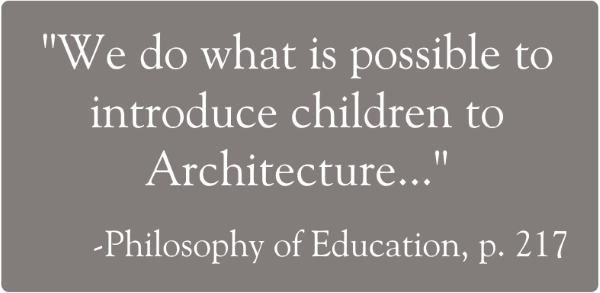
“We do what is possible to introduce children to Architecture; and we practise clay-modelling and the various artistic handicrafts, but there is nothing unusual in our work in these directions.” (Vol. 6, p. 217)

“I shall touch later upon the burning question of a curriculum which shall furnish children, not with dry bones of fact, but with fact clothed upon with the living flesh, breathed into by the vital spirit of quickening ideas.” (Vol. 3, p. 124)

If you would like to study along with us, here are some passages from The Home Education Series and other Parent’s Review articles that would be helpful for this episode’s topic. You may also read the series online here, or get the free Kindle version from Fisher Academy.

An Essay Towards a Philosophy of Education (Volume 6), Book I, Chapter 10, Section II: Art

Filippo’s Dome, Rockwell

Story of Architecture, Waterhouse

Child’s History of Art, Hiller

Architecture Shown to the Children, Wynne

Concise History of Western Architecture, Jordan

(Contains affiliate links)

In a Large Room Retreat

Golden Hours of Delight Retreat

Charlotte Mason Institute

The Duomo, Florence

Chartres Cathedral

Flying Buttresses

Rose Windows

Amiens Cathedral

Hagia Sophia, Istanbul

Episode 60: Listener Q&A #11

This podcast addresses listener questions about implementing a Charlotte Mason education. How do we teach multiple children at different levels, keep up with all the books being read, teach the subject of recitation, get our children to talk about what they’re learning?

Listen Now:

“When a child is reading, he should not be teased with questions as to the meaning of what he has read, the signification of this word or that; what is annoying to older people is equally annoying to children. Besides, it is not of the least consequence that they should be able to give the meaning of every word they read. A knowledge of meanings, that is, an ample and correct vocabulary, is only arrived at in one way––by the habit of reading. A child unconsciously gets the meaning of a new word from the context, if not the first time he meets with it, then the second or the third: but he is on the look-out, and will find out for himself the sense of any expression he does not understand. Direct questions on the subject-matter of what a child has read are always a mistake. Let him narrate what he has read, or some part of it. He enjoys this sort of consecutive reproduction, but abominates every question in the nature of a riddle. If there must be riddles, let it be his to ask and the teacher’s to direct him the answer. Questions that lead to a side issue or to a personal view are allowable because these interest children––’What would you have done in his place?'” (Vol. 1, pp. 228-229)

“Long ago, I was in the habit of hearing this axiom quoted by a philosophical old friend: “The mind can know nothing save what it can produce in the form of an answer to a question put to the mind by itself.” I have failed to trace the saying to its source, but a conviction of its importance has been growing upon me during the last forty years. It tacitly prohibits questioning from without; (this does not, of course, affect the Socratic use of questioning for purposes of moral conviction); and it is necessary to intellectual certainty, to the act of knowing. For example, to secure a conversation or an incident, we ‘go over it in our minds’; that is, the mind puts itself through the process of self-questioning which I have indicated. This is what happens in the narrating of a passage read: each new consecutive incident or statement arrives because the mind asks itself,––”What next?” For this reason it is important that only one reading should be allowed; efforts to memorise weaken the power of attention, the proper activity of the mind; if it is desirable to ask questions in order to emphasize certain points, these should be asked after and not before, or during, the act of narration.” (Vol. 6, p. 17)

“A small English boy of nine living in Japan, remarked, “Isn’t it fun, Mother, learning all these things? Everything seems to fit into something else.” The boy had not found out the whole secret; everything fitted into something within himself.” (vol. 6, pp. 156-157)

If you would like to study along with us, here are some passages from The Home Education Series and other Parent’s Review articles that would be helpful for this episode’s topic. You may also read the series online here, or get the free Kindle version from Fisher Academy.

Home Education, Part V, Chapter VIII

Recitation: The Children’s Art, Arthur Burrell

In A Large Room Retreat

TruthQuest History

Episode 59: Handicrafts

Charlotte Mason included handicrafts in the curriculum and this podcast will explore the reasons. It is not an optional activity or filler, but what is the purpose? Furthermore, what sorts of things are included in this subject and how can a mother who feels inadequate possibly fulfill this requirement?

Listen Now:


“Points to be borne in mind in children’s handicrafts are: a) that they should not be employed in making futilities such as pea and stick work, paper-mats and the like; b) that they should be taught slowly and carefully what they should do; c) that slipshod work should not be allowed; d) and, that, therefore, the children’s work should be kept well within their compass.” (Vol. 1, pp. 315-316)

“Small children finish anything set for them to do alone very quickly as a rule, and I find it a great help if they can have some easy handicraft to be picked up in spare moments.” (Parents’ Review, “Notes and Queries”, Vol. 44, p. 480)

If you would like to study along with us, here are some passages from The Home Education Series and other Parent’s Review articles that would be helpful for this episode’s topic. You may also read the series online here, or get the free Kindle version from Fisher Academy.

Home Education (Volume 1), Part V, Chapter XXI

School Education (Volume 3), pp. 355-359

Paper Sloyd for Primary Grades

(Contains affiliate link)

Paper Sloyd for Primary Grades

Golden Hours of Delight Retreat

Episode 58: Charlotte Mason and Special Needs

This episode highlights the relevance of a Charlotte Mason education for children who have unique differences as persons in one way or another, needs that affect how they relate to and respond to their education. Is Mason’s method possible for children with special needs?

Listen Now:


“Greatness and littleness belong to character, and life would be dull were we all cast in one mould…” (Vol. 2, pg. 71)

“The best public schoolboy is a fine product; and perhaps the worst has had his imagination touched by ideas; yet most of us recognise that the public school often fails, in that it launches the average and dull boy ignorant upon the world because the curriculum has been too narrow to make any appeal to him.” (Vol. 3, p. 246)

“Let me add that the appeal of these principles and this method is not to the clever child only but to the average and even to the ‘backward’ child; indeed we have had several marked successes with backward children. Just as we all partake of that banquet which is ‘Shakespeare’ according to our needs and desires, so do the children behave at the ample board set before them; there is enough to satisfy the keenest intelligence while the dullest child is sustained through his own willing effort.” (Vol. 6, p. 245)

“The teachers underrate the tastes and abilities of their pupils. In things intellectual, children, even backward children, have extraordinary ‘possibilities for good’–possibilities so great that if we had the wit to give them their heard they would carry us alog like a stream in spate.” (Vol. 6, p. 52)

“This is what we have established in many thousands of cases, even in those of dull and backward children, that any person can understand any book of the right calibre (a question to be determined mainly by the age of the young reader); that the book must be in literary form; that children and young persons require no elucidation of what they read; that their attention does not flag while so engaged; that they master a few pages at a single reading so thoroughly that they can ‘tell it back’ at the time or months later whether it be the Pilgrim’s Progress or one of Bacon’s Essays or Shakespeare’s plays; that they throw individuality into this telling back so that no two tell quite the same tale; that they learn incidentally to write and speak with vigour and style and usually to spell well. Now this art of telling back is Education and is very enriching.” (Vol. 6, pp. 291-92)

“People are too apt to use children as counters in a game, to be moved hither and thither according to the whim of the moment. Our crying need to-day is less for a better method of education than for an adequate conception of children,––children, merely as human beings, whether brilliant or dull, precocious or backward. Exceptional qualities take care of themselves and so does the ‘wanting’ intelligence, and both of these share with the rest in all that is claimed for them in the previous chapters. Our business is to find out how great a mystery a person is qua person. All action comes out of the ideas we hold and if we ponder duly upon personality we shall come to perceive that we cannot commit a greater offence than to maim or crush, or subvert any part of a person.” (Vol. 6, p. 80)

Parents’ Review article on Backward Children