
Author Archives: Admin

Episode 57: Middle & High School Math: Interview with Richele Baburina, Part 2

This Charlotte Mason podcast episode is the conclusion of a two part interview with Richele Baburina on math in the upper forms. Her research and experience, wisdom and love will not only calm your anxieties, but will reveal a glimpse of the wondrous possibilities and beauty awaiting you and your child as you explore the mountainous heights of an awe-inspiring subject, including valuable tips for traversing it with direction and confidence.

Listen Now:


“In the things of science, in the things of art, in the things of practical everyday life, his God doth instruct him and doth teach him, her God doth instruct her and doth teach her. Let this be the mother’s key to the whole of the education of each boy and each girl; not of her children; the Divine Spirit does not work with nouns of multitude, but with each single child. Because He is infinite, the whole world is not too great a school for this indefatigable Teacher, and because He is infinite, He is able to give the whole of his infinite attention for the whole time to each one of his multitudinous pupils. We do not sufficiently rejoice in the wealth that the infinite nature of our God brings to each of us.” (Vol. 2, p. 273)

“Supposing we are willing to make this great recognition, to engage ourselves to accept and invite the daily, hourly, incessant co-operation of the divine Spirit, in, to put it definitely and plainly, the schoolroom work of our children, how must we shape our own conduct to make this co-operation active, or even possible? We are told that the Spirit is life; therefore, that which is dead, dry as dust, mere bare bones, can have no affinity with Him, can do no other than smother and deaden his vitalising influences. A first condition of this vitalising teaching is that all the thought we offer to our children shall be living thought; no mere dry summaries of facts will do; given the vitalising idea, children will readily hang the mere facts upon the idea as upon a peg capable of sustaining all that it is needful to retain. We begin by believing in the children as spiritual beings of unmeasured powers––intellectual, moral, spiritual––capable of receiving and constantly enjoying intuitions from the intimate converse of the Divine Spirit.” (Vol. 2, p. 277)

“Girls are usually in Class IV. for two or three years, from fourteen or fifteen to seventeen, after which they are ready to specialise and usually do well. The programme for Class IV. is especially interesting; it adds Geology and Astronomy to the sciences studied, more advanced Algebra to the Mathematics, and sets the history of Modern Europe instead of French history.” (Vol. 3, p. 294)

If you would like to study along with us, here are some passages from The Home Education Series and other Parent’s Review articles that would be helpful for this episode’s topic. You may also read the series online here, or get the free Kindle version from Fisher Academy.

Towards a Philosophy of Education (Volume 6), Book I, chapters 8 & 9

The Story of Charlotte Mason, Chomondeley
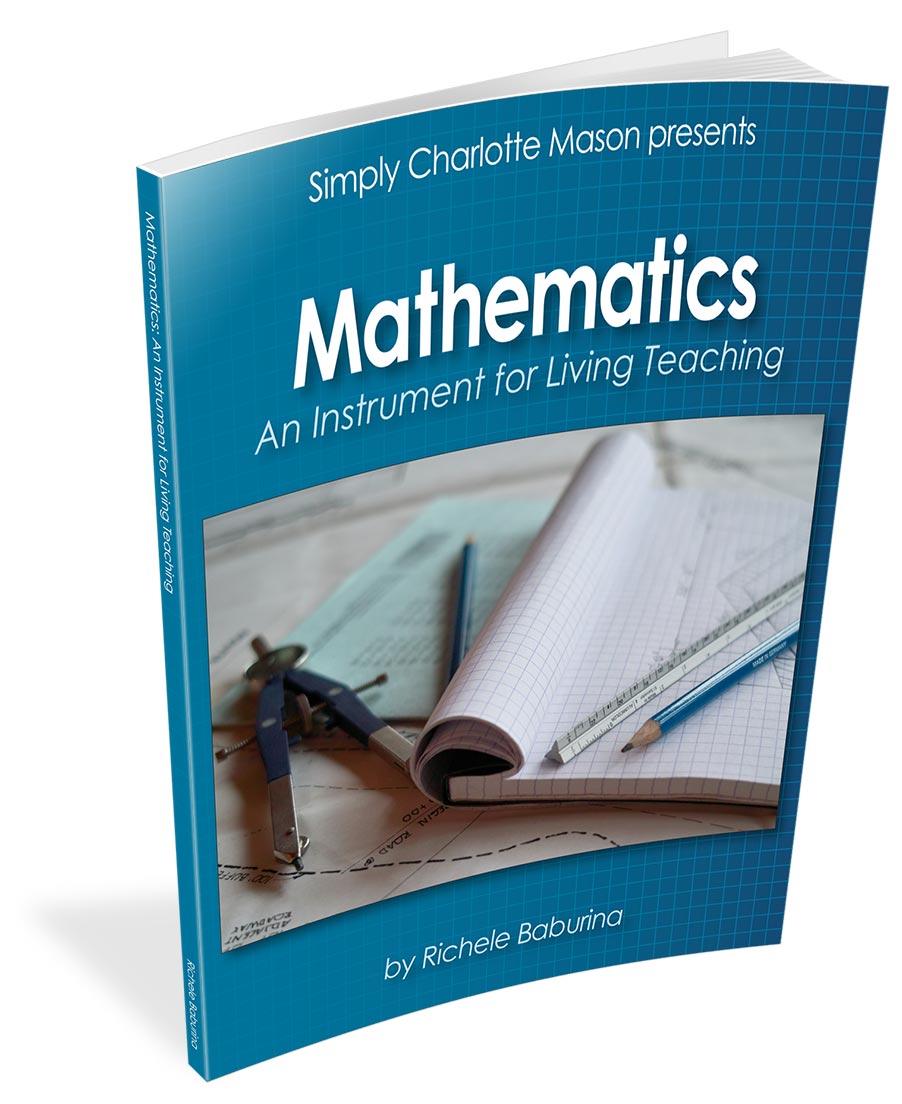
Mathematics: An Instrument for Living Teaching

First Step in Euclid

Practical Exercises in Geometry

Lessons in Experimental and Practical Geometry

Paper Sloyd

Episode 30: The Way of the Will and The Way of Reason

Episode 56: Middle & High School Math: Interview with Richele Baburina, Part 1

This Charlotte Mason podcast explores the upper reaches of the hike up the math mountain. If teaching algebra and geometry are daunting to you currently, or for the future, please enjoy the first of this two-part interview with Richele Baburina, a fellow CM researcher and practitioner who has explored the wondrous reaches of mathematics as a living subject in the Mason feast.

Listen Now:

Principles 16-19 from the Preface to the Home Education Series:

16. There are two guides to moral and intellectual self-management to offer to children, which we may call ‘the way of the will’ and ‘the way of the reason.’

17. The way of the will: Children should be taught, (a) to distinguish between ‘I want’ and ‘I will.’ (b) That the way to will effectively is to turn our thoughts from that which we desire but do not will. (c) That the best way to turn our thoughts is to think of or do some quite different thing, entertaining or interesting. (d) That after a little rest in this way, the will returns to its work with new vigour. (This adjunct of the will is familiar to us as diversion, whose office it is to ease us for a time from will effort, that we may ‘will’ again with added power. The use of suggestion as an aid to the will is to be deprecated, as tending to stultify and stereotype character, It would seem that spontaneity is a condition of development, and that human nature needs the discipline of failure as well as of success.)

18. The way of reason: We teach children, too, not to ‘lean (too confidently) to their own understanding’; because the function of reason is to give logical demonstration (a) of mathematical truth, (b) of an initial idea, accepted by the will. In the former case, reason is, practically, an infallible guide, but in the latter, it is not always a safe one; for, whether that idea be right or wrong, reason will confirm it by irrefragable proofs.

19. Therefore, children should be taught, as they become mature enough to understand such teaching, that the chief responsibility which rests on them as persons is the acceptance or rejection of ideas. To help them in this choice we give them principles of conduct, and a wide range of the knowledge fitted to them. These principles should save children from some of the loose thinking and heedless action which cause most of us to live at a lower level than we need.

If you would like to study along with us, here are some passages from The Home Education Series and other Parent’s Review articles that would be helpful for this episode’s topic. You may also read the series online here, or get the free Kindle version from Fisher Academy.

Towards a Philosophy of Education (Volume 6), Book I, chapters 8 & 9

Strayer Upton Practical Mathematics

Mathematics: An Instrument for Living Teaching

First Step in Euclid

Practical Exercises in Geometry

Lessons in Experimental and Practical Geometry
Richele’s Overview of Math Instruction based on the PNEU practice with amendments for 21st century requirements: Charlotte Mason Math Overview

Paper Sloyd

Episode 30: The Way of the Will and The Way of Reason

Episode 55: Elementary Math

This week’s Charlotte Mason podcast addresses math in the elementary years. How much should be covered? How should it be presented? How do we build confidence, competence, and progress?

Listen Now:


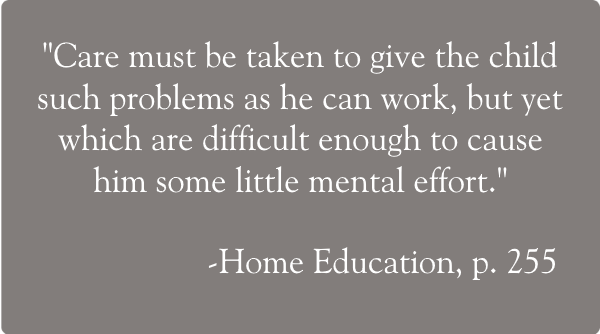
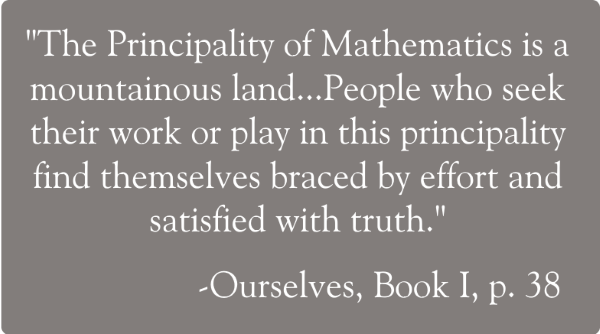
“The Principality of Mathematics is a mountainous land, but the air is very fine and health-giving, though some people find it too rare for their breathing. It differs from most mountainous countries in this, that you cannot lose your way, and that every step taken is on firm ground. People who seek their work or play in this principality find themselves braced by effort and satisfied with truth.” (Vol. 4, p. 38)

[A child should know at 12 years old:] “…g) in Arithmetic, they should have some knowledge of vulgar and decimal fractions, percentage, household accounts, etc. h) Should have a knowledge of Elementary Algebra, and should have done practical exercises in Geometry.” (Vol. 3, p. 301)

“[Mathematics] should give to children the sense of limitation which is wholesome for all of us, and inspire that sursam corda which we should hear in all natural law.” (Vol. 6, p. 231)

If you would like to study along with us, here are some passages from The Home Education Series and other Parent’s Review articles that would be helpful for this episode’s topic. You may also read the series online here, or get the free Kindle version from Fisher Academy.

Home Education, Part V, XV

Ourselves, Book I, pp. 38; 62-63

Towards a Philosophy of Education, Book I, Chapter 10, Section III

Strayer-Upton’s Books–helpful for mental arithmetic/story problems

(Contains affiliate links)

Richele Baburina’s Mathematics: A Guide for Living Teaching

Benezet’s Article on informal math instruction in the early years

Parents’ Review Article on “Number”

Episode 54: Teaching Math

How in the world did Charlotte Mason approach the subject of math? This podcast episode explores that question and addresses our qualms and insecurities in teaching math to our children. How do we avoid fears, tears, pushing and pulling, and reach to its infinite beauty as an instrument in acquiring knowledge of the universe?

Listen Now:

“Arithmetic, Mathematics, are exceedingly easy to examine upon and so long as education is regulated by examinations so long shall we have teaching, directed not to awaken a sense of awe in contemplating a self-existing science, but rather to secure exactness and ingenuity in the treatment of problems.” (Vol. 6, p. 231)

“…the use of the study in practical life is the least of its uses. The chief value of arithmetic, like that of higher mathematics, lies in the training it affords to the reasoning powers, and in the habits of insight, readiness, accuracy, intellectual truthfulness it engenders.” (Vol. 1, p. 254)

“Never are the operations of Reason more delightful and more perfect than in mathematics…By degrees, absolute truth unfolds itself. We are so made that truth, absolute and certain truth, is a perfect joy to us; and that is the joy that mathematics afford.” (Vol. 4, p. 63)

“Let his arithmetic lesson be to the child a daily exercise in clear thinking and rapid, careful execution, and his mental growth will be as obvious as the sprouting of seedlings in the spring.” (Vol. 1, p. 261)

“Mathematics depend upon the teacher rather than upon the text-book and few subjects are worse taught; chiefly because teachers have seldom time to give the inspiring ideas, what Coleridge calls, the ‘Captain’ ideas, which should quicken imagination.” (Vol. 6, p. 233)

“There is no must be to him he does not see that one process, and one process only, can give the required result. Now, a child who does not know what rule to apply to a simple problem within his grasp, has been ill taught from the first, although he may produce slatefuls of quite right sums in multiplication or long division.” (Vol. 1, p. 254)

“…’nearly right’ is the verdict, a judgment inadmissible in arithmetic.” (Vol. 1, p. 255)

If you would like to study along with us, here are some passages from The Home Education Series and other Parent’s Review articles that would be helpful for this episode’s topic. You may also read the series online here, or get the free Kindle version from Fisher Academy.

Home Education, Part V, XV

Towards a Philosophy of Education, Book I, Chapter 10, Section III

Number Stories of Long Ago

String, Straightedge and Shadow

(Contains affiliate links)

Our very favorite resource for Mathematics teaching

Episode 53: Listener Q&A #10


This Charlotte Mason podcast episode is another Q&A. As we implement the method, challenges arise: what adjustments need to be made when I come to the method late, how should I organize my home differently, and what about the only child’s needs, are this week’s focus.

Listen Now:

“It is not an environment that these want, a set of artificial relations carefully constructed, but an atmosphere which nobody has been at pains to constitute. It is there, about the child, his natural element, precisely as the atmosphere of the earth is about us. It is thrown off, as it were, from persons and things, stirred by events, sweetened by love, ventilated, kept in motion, by the regulated action of common sense.” (Vol. 6, pg. 96)

“No artificial element [should] be introduced…children must face life as it is; we may not keep them in glass cases.” (Vol. 6, pg. 97)

The Conquest of the North and South Poles (Landmark Book), Russell Owen

(Contains affiliate links)

Episode 4: Three Tools of Education

The Education of an Only Child, Mrs. Clement Parsons. The Parents’ Review, Volume 12, p.609-621