Author Archives: Admin

Episode 46: Reading


This week’s Charlotte Mason podcast focuses on the all-important task of teaching our children to read. No other subject holds such promise and so many anxieties for the teacher who embarks on teaching this fundamental skill. The ladies share their own experiences and what Mason had to say to help us in the reading lesson.

Listen Now:
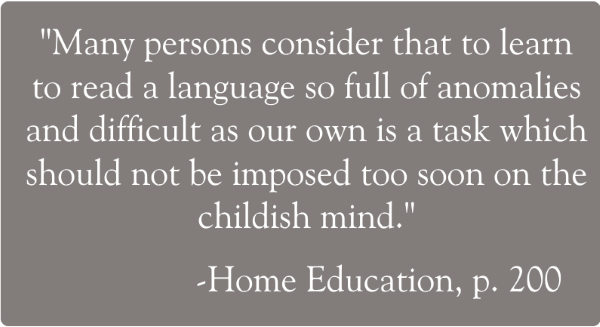

“But, as a matter of fact, few of us can recollect how or when we learned to read: for all we know it came by nature.” (Vol. 1, p. 200)

“Probably that vague whole which we call ‘Education’ offers no more difficult and repellent task than that to which every little child is set down–the task of learning to read. We realize the labor of it when some grown man makes a heroic effort to remedy shameful ignorance, but we forget how contrary to nature it is for a little child to occupy himself with dreary hieroglyphics–all so dreadfully alike!–when the world is teeming with interesting objects which he is agog to know.” (Vol. 1, p. 214)

“‘What a snail’s progress!’ you are inclined to say. Not so slow, after all: a child will thus learn, without appreciable labour, from 2-3,000 words in the course of a year; in other words, he will learn to read, for the mastery of this number of words will carry him with comfort through most of the books that fall in his way. Now, compare this steady progress and constant interest and liveliness of such lessons with the deadly weariness of the ordinary reading lesson. The child blunders through a page or two in the dreary monotone without expression, with imperfect enunciation. He comes to a word he does not know, and he spells it; that throws no light on the subject, and he is told the word; he repeats it, but as he has made no mental effort to secure the word, the next time he meets with it the same process is gone through. The reading lesson for that day comes to an end. The pupil has been miserably bored, and has not acquired one new word. Eventually, he learns to read, somehow, by mere dint of repetition; but consider what an abuse of his intelligence is a system of teaching which makes him undergo daily labour with little or no result, and gives him a distaste for books before he has learned to use them.” (Vol. 1, pp. 206-207)

“We must remember the natural inertness of a child’s mind; give him the habit of being read to, and he will steadily shirk the labour of reading for himself; indeed, we all like to be spoon-fed with our intellectual meat, or we should read and think more for ourselves and be less eager to run after lectures.” (Vol. 1, p. 228)

“He should have practice, too, in reading aloud [from the books] he is using for his term’s work. These should include a good deal of poetry, to accustom him to the delicate rendering of shades of meaning, and especially to make him aware that words are beautiful in themselves, that they are a source of pleasure, and are worthy of our honour; and that a beautiful word deserves to be beautifully said, with a certain roundness of tone and precision of utterance.” (Vol. 1, p. 227)

“The attention of his teachers should be fixed on two points–that he acquires the habit of reading, and that he does not fall into slipshod habits of reading.” (Vol. 1, p. 226)

If you would like to study along with us, here are some passages from The Home Education Series and other Parent’s Review articles that would be helpful for this episode’s topic. You may also read the series online here, or get the free Kindle version from Fisher Academy.

Home Education, pp. 199-222)

Better Late Than Early, Raymond Moore

Reading-Literature Series

Thirty Million Words, Dana Suskind

(Contains affiliate links)

Montessori Small Moveable Alphabet
Reading-Literature series on MainLesson.com

Reading Lessons Teacher Help for the Treadwell Primer

Episode 45: Listener Q&A #8


This week’s podcast episode on the Charlotte Mason method of education–the delectable education–is a question and answer session. Listen to this lively, animated, and slightly controversial discussion of short lessons, nature study, free time, and Bible lessons.

Listen Now:

“Five of the thirteen waking hours should be at the disposal of the children; three, at least, of these, from two o’clock to five, for example, should be spent out of doors in all but very bad weather. This is the opportunity for out-of-door work, collecting wild flowers, describing walks and views, etc.” (From “Suggestions” accompanying Programme 42)

“The Children’s Day will, on the whole, run thus: Lessons, 1 1/2 to 4 hours; meals, 2 hours; occupations, 1 to 3 hours; leisure, 5 to 7 hours, according to age.” (From “Suggestions” accompanying Programme 42)

“Children between 6 and 9 should get a considerable knowledge of the Bible text. By 9 they should have read the simple (and suitable) narrative portions of the Old Testament…and [the Synoptic] Gospels.” (Vol. 1, p. 249)

The Laws Guide to Nature Drawing and Journaling

(Contains affiliate links)

Episode 20: Nature Study

Episode 22: Interview with Cheri Struble

John Muir Laws’ Website

Episode 41: Interview with Jack Laws, Part 1

Episode 42: Interview with Jack Laws, Part 2

Episode 17: Bible, The Living Book

Living Books Library post on Electronics

Parents’ Review Article: Imagination is a Powerful Factor in a Well-Balanced Mind

A Delectable Education’s Schedule Cards

Episode 44: Language Acquisition


This week’s Charlotte Mason podcast focuses on language. Mason’s method was based on a child’s nature, and this is most apparent in observing how her method runs along the line of a child’s natural acquisition of language skills.

Listen Now:


“Many persons consider that to learn to read a language so full of anomalies and difficulties as our own is a task which should not be imposed too soon on the childish mind. But, as a matter of fact, few of us can recollect how or when we learned to read: for all we know it came by nature.” (Vol. 1, p. 200)

Thirty Million Words, Dana Suskind

(Contains affiliate links)

The Teaching of Mathematics: The Story of An Experiment

Episode 43: Listener Q&A #7


This week’s Charlotte Mason podcast is another Q&A session with Emily, Nicole, and Liz. It is inevitable, as we implement the feast, that questions of presentation and content arise about details not mentioned in the designated episodes on those subjects, and here are some of the latest ones.

Listen Now:

“Never be within doors when you can rightly be without>” (Vol. 1, p. 42)

“There is no selection of subjects, passages, or episodes on the ground of interest.” (Vol. 6, p. 244)

Anne White’s Plutarch Books can be found here

(Contains affiliate links)

Nancy Kelly on Plutarch

Anne White’s Study Guides free online

Overdrive Media Console

Episode 42: Interview with John Muir Laws, Part II


Charlotte Mason knew nature study is critical to the good life and fundamental to education. This week’s podcast is the second interview with contemporary naturalist John Muir Laws (Jack) in which he inspires, encourages, and explains to us not only what to do when we go outside, along with many how-to practices we can implement to make the most of that nature study, but how we can change our motivation and focus to experience a rich and rewarding relationship with nature.

Listen Now:

Last Child in the Woods, Richard Louv

The Nature Principle, Richard Louv

The Laws Guide to Nature Drawing and Journaling, John Muir Laws

(Contains affiliate links)

Jack Laws’ Website

Jack Laws’ Nature Journal Suggested Supplies List

Nature Journaling Club Curriculum

Jack’s Blog Post on his favorite blue pencil

CMPeoria “The Field Before Us” Regional Retreat