Author Archives: Admin

Episode 36: Literature


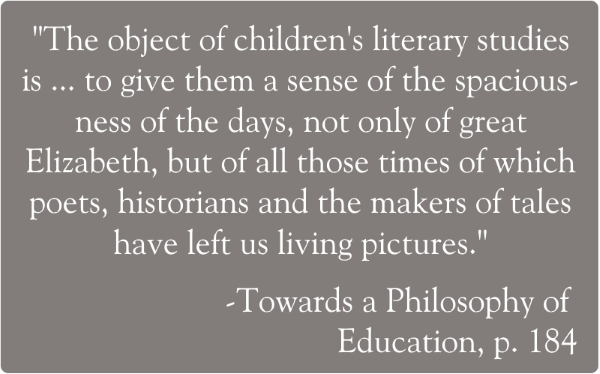
This week’s podcast focuses on Charlotte Mason’s ideas for the study of literature. Wait, isn’t every subject literature with her use of living books? How does the study of literature fit into her curriculum from the earliest age?

Listen Now:

“Except in Form I the study of Literature goes pari passu with that of History.” (Vol. 6, p. 180)

“It is a nice question whether the history of a country makes its literature or its literature the history!” R.A. Pennethorne, Parent’s Review, Volume 10, 1899, p. 549

“To adapt a phrase of Matthew Arnold’s concerning religion,––education should aim at giving knowledge ‘touched with emotion.'” (Vol. 3, p. 220)

“I know you may bring a horse to the water, but you cannot make him drink. What I complain of is that we do not bring our horse to the water. We give him miserable little text-books, mere compendiums of facts, which he is to learn off and say and produce at an examination; or we give him various knowledge in the form of warm diluents, prepared by his teacher with perhaps some grains of living thought to the gallon. And all the time we have books, books teeming with ideas fresh from the minds of thinkers upon every subject to which we can wish to introduce children.” (Vol. 3, p. 171)

“The ‘hundred best books for the schoolroom’ may be put down on a list, but not by me. I venture to propose one or two principles in the matter of school-books, and shall leave the far more difficult part, the application of those principles, to the reader. For example, I think we owe it to children to let them dig their knowledge, of whatever subject, for themselves out of the fit book; and this for two reasons: What a child digs for is his own possession; what is poured into his ear, like the idle song of a pleasant singer, floats out as lightly as it came in, and is rarely assimilated. I do not mean to say that the lecture and the oral lesson are without their uses; but these uses are, to give impulse and to order knowledge; and not to convey knowledge, or to afford us that part of our education which comes of fit knowledge, fitly given.” (Vol. 3, p. 177)

If you would like to study along with us, here are some passages from The Home Education Series and other Parent’s Review articles that would be helpful for this episode’s topic. You may also read the series online here, or get the free Kindle version from Fisher Academy.

Home Education, Part V, Chapter VIII

School Education, Chapters XV and XXI

Towards a Philosophy of Education, Book I, Section II (b)

Beowulf

The Odyssey

The Iliad

Ivanhoe

T.S. Eliot’s Essays

To Kill a Mockingbird

Pride and Prejudice

The Red Badge of Courage

English Literature for Boys and Girls

Honey for a Child’s Heart

Read for the Heart

Realms of Gold

Five Years of Children’s Literature

(Contains affiliate links)

Top 10 Books about Books

Episode 35: Listener Q&A #5


This podcast episode on the Charlotte Mason method of education focuses on some listener questions, notably, what to do about dawdlers, how to motivate apathetic students, and a couple of particulars about implementing history lessons.

Listen Now:


“Education is a life; that life is sustained on ideas; ideas are of spiritual origin; and, ‘God has made us so’ that we get them chiefly as we convey them to one another. The duty of parents is to sustain a child’s inner life with ideas as they sustain his body with food.” (Vol. 2, p. 39)

Carry On, Mr. Bowditch

String, Straightedge, and Shadow

The Story of Geronimo

I Buy a School

Young Fu of the Upper Yangtze

The Boy Who Harnessed the Wind

Stillwell and the American Experience in China

(Contains affiliate links)
Episode 34: Picture & Composer Study


This podcast episode’s focus describes Charlotte Mason’s inclusion of art and music in her essential curriculum. How has our cultural and educational background prejudiced us to favor core subjects over “fine arts” and how did Ms. Mason view these subjects. Further, how are these subjects included and implemented in the week’s feast–especially if the mother is unfamiliar or even fearful of tackling this unknown territory?

Listen Now:


“We cannot measure the influence that one or another artist has upon the child’s sense of beauty, upon his power of seeing, as in a picture, the common sights of life; he is enriched more than we know in having really looked at even a single picture.” (Vol. 1, p. 309)

“They are never copied lest an attempt to copy should lessen a child’s reverence for great work.” (Vol. 6, p. 216)

“A great promise has been given to the world––that its teachers shall not any more be removed. There are always those present with us whom God whispers in the ear, through whom He sends a direct message to the rest. Among these messengers are the great painters who interpret to us some of the meanings of life. To read their messages aright is a thing due from us. But this, like other good gifts, does not come by nature. It is the reward of humble, patient study.” (Vol. 4, p. 102)

“As in a worthy book we leave the author to tell his own tale, so do we trust a picture to tell its tale through the medium the artist gave it.” (Vol. 6, p. 216)

“[F]or though every child cannot be a great performer, all may be taught an intelligent appreciation of the beauties of music, and it is a wicked shame to clang the doors of music, and therefore of endless channels of delight and inspiration, in a child’s face, because we say he has “no ear,” when perhaps his ear has never been trained, or because he never will be able to “play.”” (Miss Pennethorne’s PR Article)

“Hearing should tell us a great many interesting things, but the great and perfect joy which we owe to him is Music.” (Vol. 4, Book I, pp. 30-31)

“Use every chance you get of hearing music (I do not mean only tunes, though these are very nice), and ask whose music has been played, and, by degrees, you will find out that one composer has one sort of thing to say to you, and another speaks other things; these messages of the musicians cannot be put into words, so there is no way of hearing them if we do not train our ear to listen.” (Vol. 4, p. 31)

“Many great men have put their beautiful thoughts, not into books, or pictures, or buildings, but into musical score, to be sung with the voice or played on instruments, and so full are these musical compositions of the minds of their makers, that people who care for music can always tell who has composed the music they hear, even if they have never heard the particular movement before.” (Vol. 4, p. 31)

If you would like to study along with us, here are some passages from The Home Education Series and other Parent’s Review articles that would be helpful for this episode’s topic. You may also read the series online here, or get the free Kindle version from Fisher Academy.

Home Education, Part V, Chapter XXI

School Education, p. 239

Towards a Philosophy of Education, Book I, Chapter X, Section II: f

Benjamin West and His Cat Grimalkin, Marguerite Henry Stories of Favorite Operas, Clyde Robert Bulla More Stories of Favorite Operas, Clyde Robert Bulla
Stories of Gilbert and Sullivan Operas, Clyde Robert Bulla The Ring and the Fire, Clyde Robert Bulla I, Juan de Pareja, Elizabeth Borton de Trevino
Opal Wheeler’s Composer Biographies Millet Tilled the Soil, Sybil Deucher Art for Children series by Ernest Raboff
Elizabeth Ripley’s Artist Biographies Spiritual Lives of Great Composers, Patrick Kavanaugh I, Vivaldi, Janice Shefelman

(Contains affiliate links)
Emily’s Picture Study Portfolios

Riverbend Press Artist Prints

Episode 33: Scheduling a Charlotte Mason Education


This Charlotte Mason podcast focuses on time management: how do we get organized to spread this feast of innumerable subjects, how do we fit everything in, and how do we manage multiple children at various levels with differing needs and subjects. Practical tips, resources, ideas, and time-tested wisdom is abundant in this conversation.

Listen Now:


Our Podcast Episode that talks about the Habit of Attention

Nicole’s step-by-step guide to preparing your CM schedule

A Form by Form breakdown of which subjects are studied when and what lessons those subjects include at each age level

Liz, Emily, and Nicole can help you create your own schedule and/or custom curriculum

Episode 32: The Perilous Privilege of Mothering


This week’s Charlotte Mason podcast celebrates the role of mothers in their children’s education. Ms. Mason had plenty to say to us as mothers and we share our own experiences as mothers in an effort to encourage you. This one’s for you, Mom.

Listen Now:

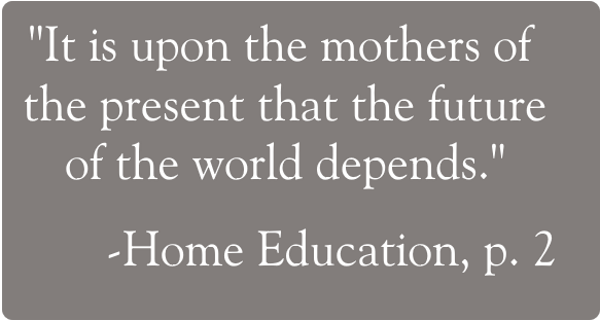
“The children are, in truth, to be regarded less as personal property than as public trusts, put into the hands of parents that they may make the very most of them for the good of society. And this responsibility is not equally divided between the parents: it is upon the mothers of the present that the future of the world depends, in even a greater degree than upon the fathers, because it is the mothers who have the sole direction of the children’s early, most impressible years.” (Vol. 1, p. 2)

“We are waking up to our duties and in proportion as mothers become more highly educated and efficient, they will doubtless feel the more strongly that the education of their children during the first six years of life is an undertaking hardly to be entrusted to any hands but their own. And they will take it up as their profession––that is, with the diligence, regularity, and punctuality which men bestow on their professional labours.” (Vol. 1, pp. 2-3)

“We allow no separation to grow up between the intellectual and ‘spiritual’ life of children, but teach them that the Divine Spirit has constant access to their spirits, and is their Continual Helper in all the interests, duties and joys of life.” (Charlotte Mason’s 20th Principle of Education)

“I venture to suggest, not what is practicable in any household, but what seems to me absolutely best for the children; and that, in the faith that mothers work wonders once they are convinced that wonders are demanded of them.” (Vol. 1, p. 44)

I Buy a School, Marion Berry

The Story of Charlotte Mason, Essex Cholmondeley (We are in no way suggesting you buy this book for the current price! Linking solely for your information)

(Contains affiliate links)
Liz’s talk on Mothers (audio download)

ADE Podcast Episode that describes the Great Recognition further